I was thinking, while doing an ECG for my new hip, I was thinking that the ECG was similar to my moods, little peaks and lows, smaller, wider, higher, lower. I was also thinking of how polarised my mood peaks are, with a high = collect, and low = discard. In the high peaks I get excited about collecting everything, creating, reading, watching, doing, a magical whirlwind of stuff. In the lows, I entrust my memory with all the work, and believe that anything written, anything physical, will choke me more than give me joy. All of these waves are as frequent as the ECG, it's the rough sea of my life, and the more I sail it, the less I seem to know the way. I spend quite some time in these ruminations, trying to convince myself that collecting, keeping, writing down, making, is always good, even when the belief wavers. And I get a shiver of happiness thinking of Leonardo writing about his soup becoming cold, and Tolstoy's diaries, so many that nobody will ever accomplish the task of translating them all. Yet Tolstoy didn't write his diaries for 15 years. 15. OK, he was writing War and Peace, in the meantime, and maybe then watching football on TV (I know what you are thinking). But for 15 years his ECG must have changed. And Leonardo was not always happy, or hardly ever, for that matter. So, it's not about happiness, most things aren't. Perhaps it's about sharing. You collect, you preserve, you share. But then, in the lows, I wonder whether it really is important to share, whether it is even possible. And all the work that goes in it, self promotion, the effort (not much) to be understandable, or just to be present. But in the highs of travel, the exploration of new, old, rediscovered, reframed, there is so much, so much wonderful stuff, that quickly leaks away through the sieve of memory, and it's lost forever. Or not. I'm not sure. Did writing about soup help Leonardo fly?
Showing posts with label memory. Show all posts
Monday, 7 March 2016
Scava ombre profonde
I was thinking, while doing an ECG for my new hip, I was thinking that the ECG was similar to my moods, little peaks and lows, smaller, wider, higher, lower. I was also thinking of how polarised my mood peaks are, with a high = collect, and low = discard. In the high peaks I get excited about collecting everything, creating, reading, watching, doing, a magical whirlwind of stuff. In the lows, I entrust my memory with all the work, and believe that anything written, anything physical, will choke me more than give me joy. All of these waves are as frequent as the ECG, it's the rough sea of my life, and the more I sail it, the less I seem to know the way. I spend quite some time in these ruminations, trying to convince myself that collecting, keeping, writing down, making, is always good, even when the belief wavers. And I get a shiver of happiness thinking of Leonardo writing about his soup becoming cold, and Tolstoy's diaries, so many that nobody will ever accomplish the task of translating them all. Yet Tolstoy didn't write his diaries for 15 years. 15. OK, he was writing War and Peace, in the meantime, and maybe then watching football on TV (I know what you are thinking). But for 15 years his ECG must have changed. And Leonardo was not always happy, or hardly ever, for that matter. So, it's not about happiness, most things aren't. Perhaps it's about sharing. You collect, you preserve, you share. But then, in the lows, I wonder whether it really is important to share, whether it is even possible. And all the work that goes in it, self promotion, the effort (not much) to be understandable, or just to be present. But in the highs of travel, the exploration of new, old, rediscovered, reframed, there is so much, so much wonderful stuff, that quickly leaks away through the sieve of memory, and it's lost forever. Or not. I'm not sure. Did writing about soup help Leonardo fly?
Sunday, 29 June 2014
Stuff
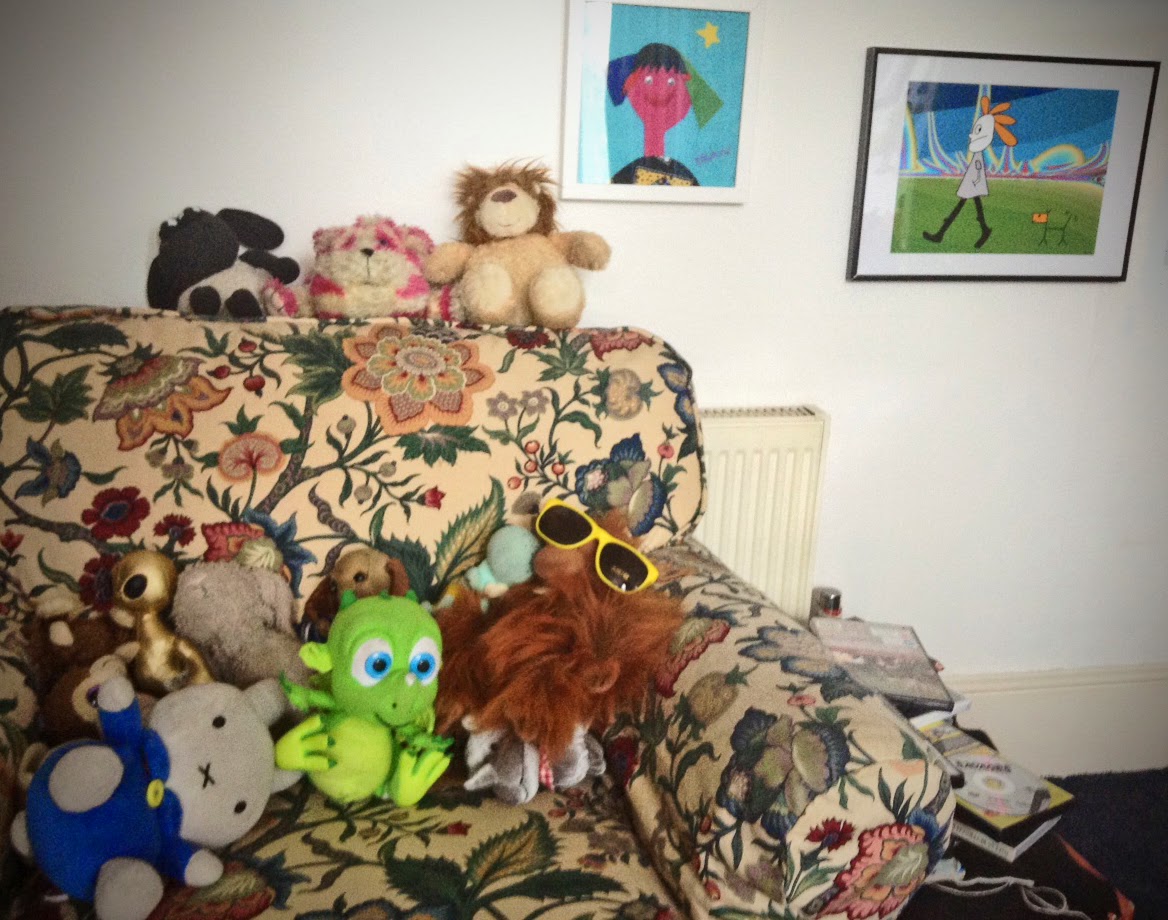
In my caravan I have no tv, no wi-fi, just a few books, old illustrated maps of the continents, and a couple of my jazz bottles with Queen Ida and a blue Miles Davis. I also have silence. A silence so deep, sometimes it's almost scary. But mostly beautiful. I can stare at the flowery curtains and drift away into a natural meditative state. I also have a few pens and colours and paper. Sometimes I draw, sometimes I just sit outside reading travel books and feeling the grass with my bare feet. Everything is perfect. Then I come back home, open the door, and I am immediately overwhelmed by... stuff. I've accumulated so much stuff, books, cds, gadgets, art supplies, cameras, nick-knacks, pictures, canvasses, art magazines, sketchbooks, full and blank. I sit on my couch, shoving some of the fluffy toys and cushions out of the way and I stare at the blank tv with a sense of dismay and anxiety. Why? Because every single object requires a decision - namely, should I use it or not. And it entails further decisions to make, such as how to use it and why. The other source of anxiety is the fear of losing what I've got. Apart from physically losing something, there is the retrieving form of losing. I flicked through a Tate magazine that had an article on Malevich, and when I put the magazine into the recycling bin, I thought, "Now I am not going to remember Malevich, his work, his theories, his sputniks and planits." And that made me incredibly sad. I write, sometimes I write a lot, in notebooks, in my computer, on my phone. But where does all the stuff I write end up? How do I archive it for retrieval? The simple caravan life is lost in the city, with its deluge of information and stuff that should be used, retained, accessed, retrieved, remembered. And a flowery curtain is not enough to induce meditation under the bombardment of phone calls, emails, post, bills, magazines, tv. And then there are art galleries, exhibitions, sketching and photography outings. A sea of stuff.
I often wondered why monks choose gardens, ponds, rocks, mountains or the sea to meditate. I thought that was cheating. Too easy to go to a beautiful place, sit on a solitary bench in the sun and watch kois glide by in the pond, perhaps with dreamy wind chimes and birds singing in the background. Because then you go back to all your stuff, and your heartbeat is raised, by millions of stimuli and a sense of guilt and powerlessness. But someone explained to me that the more you expose yourself to calm, meditative environments, the easier it becomes to access that state, to remember it when you are surrounded by stuff. So here is what I learnt in two days on my caravan. I don't NEED stuff. I don't need to retrieve or archive anything apart from what gets automatically stored and catalogued in my memory. I will remember Malevich when I need to. Or not, and then I'll do without his sputniks and black paintings, because I will be engaged in something equally valuable. As to my writings, it will be a constant journey of rediscovery, like a goldfish in a bowl swimming past a castle. Oh what a beautiful castle.
Sunday, 23 February 2014
Imaginary grannies
I walked by Valance Road the other day. 'Valance' was one of the new words I learnt when I first moved to London many centuries ago. I had found a bedsit (as you do) and went to the market to buy bedsheets. I discovered that some of them were 'valanced'. I associate that moment with a bizarre calm in the turmoil of leaving friends and family for a new, lonesome, adventure. For I immediately associated 'valance' with a world of grannies. British or American grannies - not Italian for some reason - with floral wallpaper, freshly made cakes and... well, valances. My first Christmas in London was a lonely affair, my friends went off to their families, and I was left in my bedsit, staring at a dirty wall, partly redeemed by a gigantic Marylin poster. Then I decided to buy myself some presents, including a pink, flowery make-up bag with frills and lace. A gift from my imaginary granny. Moving to a different country entails some re-rooting. There's the excitement of a new life and there is also a profound sense of loss, that needs some dams put in strategic places. Imaginary grannies are great for that. With time, I learnt that what makes continuity less continuous than we would like it to be, is not just moving somewhere else, changing language and all that, but also that everything is always moving, you are ageing and so is the world. In other words, it's not just location, but time that makes your sense of reality way less real. The first sheets I bought in London were the first sheets I ever bought in my life. For what I know, there might have been valanced sheets in Italy too. Should you be interested, there is a particular type of valance called Italian valance, quite grand, actually. So, in a way it's where your attention goes at different times in life that determines your knowledge of the world and the way in which you write history. We are hardly ever aware of things we don't need.
I never met my imaginary granny, but many times I walked into her environment, and felt peace. My caravan in Kent is one such place. It's a static caravan from the Seventies with wonderfully clashing patterns, black and orange carpet, wallpaper with pink flowers and... valanced blue curtains. I would never choose such a candyfloss interior design, but it feels peaceful because, when I am not there, my imaginary granny is, baking apple pie and remembering a past that, just like mine, never really existed.
Subscribe to:
Posts (Atom)

