Wednesday, 15 October 2014

What travels


You are here. Your senses tell you so with certainty. You can touch the surfaces and taste that scrambled egg you just cooked. You sit in the hot-tub wondering if a big black bear is going to climb over the fence. You hear the fountain trickle. You are here. But not in a permanent, historic sense. No time continuum has brought you here, a job or family in Tahoe, a cabin for sale. No, you are here, but only in the moment. Now. You are here NOW. But if now is all that ever exists, then, if you really, really, relaxed into this immense feeling of belonging, you would perhaps find the KEY that shifts you into a different continuum, the one with the past and the future you always wanted. In this expanded windy morning, out in the desert, in a later now, you try to imagine what kind of act of rebellion or enlightenment would have brought you to live here, in that other life, of which you are only living, intensely, the now. Later still, you look in the mirror, the same mirror you looked into last year, and the year before. You have more wrinkles, you are skinnier, fatter, fitter, less fit than before. You discover that now, as you are not protected by your continuum. You are naked. You also find that you are not as flexible, nice and funny as you thought you were. Divided as you are between fear and bliss.
As you travel, you morph into a new person, you shed some resentment and grow jewellery, new t-shirts and hats, sunglasses and a tan. All of these things, you think, will keep me here. Time is slow at first, and during the walks on the beach with your travelling companion, the now and the future of here seem so permanent, so exciting, so infinite. And your past, really, doesn't feel that real. It's a remote blue planet seen from space, round and simple, easy to conquer. Your life seems easy to conquer. As the journey progresses and time suddenly accelerates into shorter and shorter nows, the walks and talks on the beach change intensity, not so much about future adventures, but on ways to bring back all of this, to pack this light, this sun, the funny dogs that lick your knees, the chollas, the desert, the swimming pools, how to pack all of this in your 23kg suitcase. And, in the safety of distance, you approach conversations based on change, on solving, on climbing mountains, conquering the universe. But the very last night, while emptying bins full of your discarded bottles, hiding in the shelves the books you thought you might want to read and now are not so sure. While you pack all your knick-knacks, bits of stones and driftwood, the pain of separation becomes overwhelming, the light seems to dim, and you find yourself walking with your partner on a dark beach, staring at the stars, and feeling that you are now torn even from him. Because you've failed. You failed to find the KEY.
Silence on the plane. You try to sleep but your eyes are full of images going faster and faster. And then. Then you are here. For real. Although, it doesn't seem real at all. The key fits the lock. You slip back into your continuum. But it doesn't feel right, at all. You sit on what you rationally know is your couch, and think, I can't cope. I WILL NEVER COPE AGAIN. You open the suitcase, pull out all your knick-knacks and new t-shirts and put them on the floor. They are all dead. You take your socks off, and there is sand between your feet. You look at your partner, shyly, "We are still there, aren't we?". We are still there, where we belong. In a life without continuum and just an expanded intense magical now. You realise that all the stuff you put in your suitcase, the sun, the rented car, the museum tickets, has lost its fizz, like imported champagne. You are here, again, naked.
Too much sleep or not enough sleep, images flitting, tan fading, bills paying, going for local walks, slowly, some of your cachinas end up on the TV shelf, some new recipes sneak into your cooking routine, and a sense of achievement, peace and expansion slowly takes over. We were there, you say. We were there, together.

Saturday, 27 September 2014

Want what you find

I have been blessed lately by lack of internet access. Of course it doesn't feel like a blessing at first, like when you find a lot of acorns and wonder if they are edible, but, alas, you can't "look it up". So you start writing your little or long "look up" lists with everything that you would like to read, make, find out. Find out how mad Mark Twain really was, so that you can enjoy Roughing it a bit more. Without google or wikipedia telling you what to think, well, you have to make up your own mind. You also suddenly have a lot of free time to surf the world instead of the screen. To look around instead of up. And things start serendipitoulsy to appear, like a book on zen philosophy ( The way of zen) that tells you that rational thinking is not that rational, that after we have weighed all our information scientifically we still make decisions based on a hunch. The same book also explains i-ching as divining the lines on tortoise shells, but, should you not have a tortoise handy, you can just look around (not up), because signs are everywhere, they are there to show you your path, to give you solutions. But by now your look up list is so long you need about 10 starbucks cappuccinos to find out how to make books out of brown paperbags, how to recycle old books to use as photo albums and whatever other creative ideas you need a bit of visual inspiration for. And that is when you remember how tedious it is to try and find what you want , how many dead ends, how many digressions, how lost you get, how full your stomach with frothy milk. And this is when you finally realise the secret for a happy life: don't try and find what you want, just want and treasure what you find. Serendipity will help you (and save you from cappuccino overdose).

Sunday, 24 August 2014

Beryl Bainbridge, envy or not at all, just sunshine


Looking at a slither of Thames from the back cofee tables at Somerset House with the sun playing hide and seek with the clouds and with the temperature, and me putting my jacket on and off at all the wrong intervals, while pondering whether I still feel envy, my friend asks me if I am still writing my blog. "Of course I am", I reply lying. Well, not exactly lying, it's just that instead of writing first and thinking after, or as I go along, I wait for that ephemeral thing called inspiration. And, as inspiration comes at the most awkward times, like when you don't have a pen, a computer, it's raining, you are standing on a bus. Then of course you can repeat what you want to write over and over as a mantra, but by the time you get home, you are already sick of it. So that's what happened to last week's skipped blog. I was going to write about the Italian P.E.N. Club, on how becoming a member in 2007 was/could have been a life changing experience. How it wasn't so, for various sad personal circumstances. And how I had thought about that upon receiving a copy of the magazine and reading about Mario Luzi, the Italian poet. The articles about him were describing his sunny apartment in Florence, the gentleness of his person and thoughts, his long walks even when in his eighties. And I felt something, something that in the past perhaps would have been envy. But it was a softer feeling. I had been myself  in his sunny flat in Florence to interview him when I was a rebellious young radio presenter. And yes, everything seemed gentle to me too. And the bright light was there, just as described in these articles about him. If you are a human being that has touched the heart of a number of other humans, they will collect little precious memories of you, they will remember how the sun shone on you. That, I guess, is what saddens me, more than makes me jealous. When I'll be gone, everything will be put into a pile for the recycling centre, all my dreams, all my little collections of stones, all my many collaged journals. And a similar emotion I felt looking at the Bainbridge art exhibition. Look at this woman, I was thinking, she did what she enjoyed, was successful at it, and had the space and confidence to paint, draw, write and doodle on journals during her travels. Everything preserved, because she touched the heart of many. She had the life I wanted to have, so I could be envious. But she didn't, did she? She didn't live a life that I could have lived. Because I'm different, doing different things. So what exactly should I be jealous or envious of? Because everything she had was a reaction or interaction with her circumstances, which are not mine, and what I do or not do is an interplay with my own circumstances. That's why I am not capable of envy anymore, only of dreams of getting where I want to go, or strategies to be as happy here as I would be up there at the top of that success that opens your world to time, connections and people who will preserve your treasures. It's all good, even down here, sipping cappuccino and reminiscing, looking at the Thames, the sun, the clouds and the end of another summer.

Tuesday, 5 August 2014

Malevich and me


At the Malevich exhibition half of me flies out of my body, leaves the Tate, London, and ends up, old, in a dark an sparsely furnished apartment in Genoa - an artist, finally, telling a story. My story, or my father's story, I am not sure. But something that seems to make a lot of sense. "However confusedly and meaninglessly our way may deviate from our desires, after all it does lead us inevitably to out invisible goal.", says Stefan Zweig in The World of Yesterday. Suddenly the tense muscles of exile relax and I feel the purpose, the continuity, the explanation for it all, for my journey, my suffering, my search. It's all very beautiful. Except for one thing. It's an impossibility. I cannot tell my story, or my father's story, or his father's story in a dark flat in Genoa. Because we are all dead. My ancestors, as they really are not here to influence or take part in the events, and I, because there is no "back" to go to. This is not how it's done. The only people I can talk to are the living or the not as yet living. While the only people I want to talk to, the only people I want validation from, are the dead. I want to be a Russian suprematist, yet think that the graph paper I am sketching on should be already tanned with age. It is, indeed, a senseless proposition. The game has to be played in a different way. But which? The past always makes more sense than the future. Anxiety flies out of the past. About ten years ago I was asked to translate Pirandello's Henry IV into English for Tom Stoppard. I read Pirandello as a kid, but found him claustrophobic. Something to do with his nose, while I had just discovered at the age of 12, that I had a nose between my eyes that blurred somewhat my vision. Pirandello came back many years later, this time in an apt text, because longing for home is often longing for our roots, in other words for the comfort of the past. "Whatever happens has happened, however painful the events and brutal the battles, they're history and nothing can change them... so you can sit back and admire how every cause leads obediently to its effect, with perfect logic...", says Henry IV. In the present, the past is safe, yet, when it was present it was uncomfortable and insecure and as illogical as the present is now. What we really want is logic, the logic that seems so clear when we look at the past - cause and effect - so linear. There is where home is, the comfortable place of logic. This whole exile thing feels more and more like Schrödinger's cat. I can only go home if I don't exist anymore. I can only go home if I am already there and have never left. But perhaps I should be grateful for that. The beauty of travel, the beauty of the present and the future is, ultimately, the lack of certainty. ZAUM = Beyond reason. ZAUM = Beyond logic. ZAUM. How peaceful Malevich's anxiety feels today.

Friday, 18 July 2014

Identity, belonging & cheap hotels


I was a film extra for fifteen years and did a lot of costume drama, period and sci-fi. What was fascinating was how the costumes - and to a lesser degree the settings - changed our personality. We identified with the clothes, we became our characters. To the point, even, that all the guards, all the uniformed characters, would sit together at the same table for lunch. We all have our rituals, and these rituals give some roots and solidity to our sense of identity. We make tea or coffee in a certain way, drink it from our favourite cup. We have our breakfast in a certain way, in a certain place in the house, we even dress in a certain order. And, obviously, we also surround ourselves with things that are of our choice, that are familiar and make us know, without a doubt, that we are who we are, and are where we are at. But when we stay in a hotel room, or are guests in someone's house, all of that goes out the window. I am choosing here to talk about cheap or average accommodations and not luxury hotels, because I am interested in the quirks and in how we adapt or react. For instance, last week I was in a hotel room. It wasn't too bad, quite decent and clean. But the sheets felt damp. Why? Were they really damp? I touched the walls and they were dry. And it was cold. I am always cold, but at home I have all my blankets and central heating. Here, I found a heater and after a mighty struggle I managed to turn it on. Then I proceeded to make myself a cup of tea. I had brought my own tea, just in case. The kettle didn't fit under the tap, so I filled it with tiny glasses of water, one at a time. The cups were tiny too. I felt really clumsy in my attempts to create a routine that fitted all this stuff that wasn't mine with my personality. But my personality was already changing. The irrational part of me was trying to figure out, "Who am I? How did I end up in a room with damp sheets, silver wallpaper, and very small cups? Am I this room? Is this room a result of me? And what sad me would end up living here?" As a foreigner in a foreign land for nearly 30 years, I have always been very interested in the feeling of belonging. What makes you feel that you belong? Familiarity? Purpose? Acceptance? In that hotel room, I started feeling that belonging is when your rituals feel right. I was learning my environment already, adapting to it, and transforming it, so that my rituals felt more real and familiar. I quickly adapted to the kettle and the small cups. I put my ipod with guitar jazz radio in an empty drawer to amplify it, and wrote. Writing always feels comfortable, and profoundly me. "This hotel room," I started to think, "is not my story, but it will become my history, part of my past, yet it's not an interaction on equal grounds. My input, the music, the tea, cannot quite overcome the old blue carpet, the damp sheets, the small cups." I wondered if in order to feel that we belong we need to be on equal grounds in the giving and taking. Because my irrational me could not make sense of how I ended up there, I lost part of my history, and started fresh, like an explorer. I tried to find more ways to personalise my space, I bought a vintage dolly and a small red penguin that I put on her lap, almost like a Mexican apparition, and then started making some very rough collages (I had no scissors) of the stuff I had come across during the day, gluing everything on paper shopping bags. I would then hang the handle on the bathroom door or the closet's. Soon, a bizarre sense of belonging formed, not the me who is writing in my flat now, but another me, with less history, who had blended into an affinity with the place, and struck a decent compromise between mild squalor and creativity. Perhaps creativity is the number one ingredient that makes you belong.

Sunday, 6 July 2014

Points of view


By chance, I came across an article my father wrote in 2002 about the view from our Genoa flat. The view was indeed amazing, over the greenhouse with its palm trees, the whole city and, on a clear day, the sea. To the left there was a castle. Throughout my youth, I used to look from the window, at the grey slate roofs and the castle, which, against the setting sun, sometimes looked like a skull. I loved that flat, and it will always be in my heart. So, holding back the tears, I read my dad's article, curious and scared to learn how he felt about the place. It turned out - and actually I should have remembered - that, while I, in my room, was looking ahead, at the buildings, the castle, and the sea, my father, in his study, was looking through his bay window at the winding road. And while he was looking and thinking of all the years gone by, of his ghosts from the war, he was also waiting for me to come home. This image, this different point of view, the looking ahead and the looking to the side, made me suddenly see a different person, not my father, the all-knowing, the powerful, the wise, the giant, but a man, a mortal, with all his insecurities, fears, and sorrows. As I don't have children, I never really think of what it must be like to be a parent, of how mysterious a young life must appear. Mysterious and worrisome, fragile, yet in need of space and trust in order to grow. Being a rebellious, exploratory and dreamy child, I must have appeared particularly mysterious to him, while he pondered on how to be a good father, looking at the winding road from the bay window. Sometimes, out of desperation, he would make me sit on the couch and read to me from the Ecclesiastes, 'To every thing there is a season, and a time to every purpose under the heaven:, A time to be born, and a time to die; a time to plant, and a time to pluck up that which is planted...' He was hoping to slow me down, to make me wait until I was more prepared. But the time was right, it was the right time for me. Now, I like to think of this sense of time as an intuitive clock, that has its natural speed, its right time for things. Even though my fast clock was cause of concern for my father, back then, I followed its rhythm, like a dog on a walk, sometimes running, sometimes stopping to investigate a scent or a movement. It was only later in life that I started fighting against my clock, wanting to learn things faster, to work harder, more and more, in order to get to that place that is supposed to be my destination. But my intuitive clock thinks otherwise, 'To everything there is a season... a time to get and a time to lose.' The journey will take the time it needs to take, for how valiantly I fight against windmills. I am glad I didn't know that my father was not omniscient when I was a child and needed to think it was possible to have control over our own lives. And I am glad that my intuitive clock has shown me a different version of my father today, today that I am the same age he was then, when he sat on his chair and read me from the Ecclesiastes. There is indeed a time for everything.

Sunday, 29 June 2014

Stuff


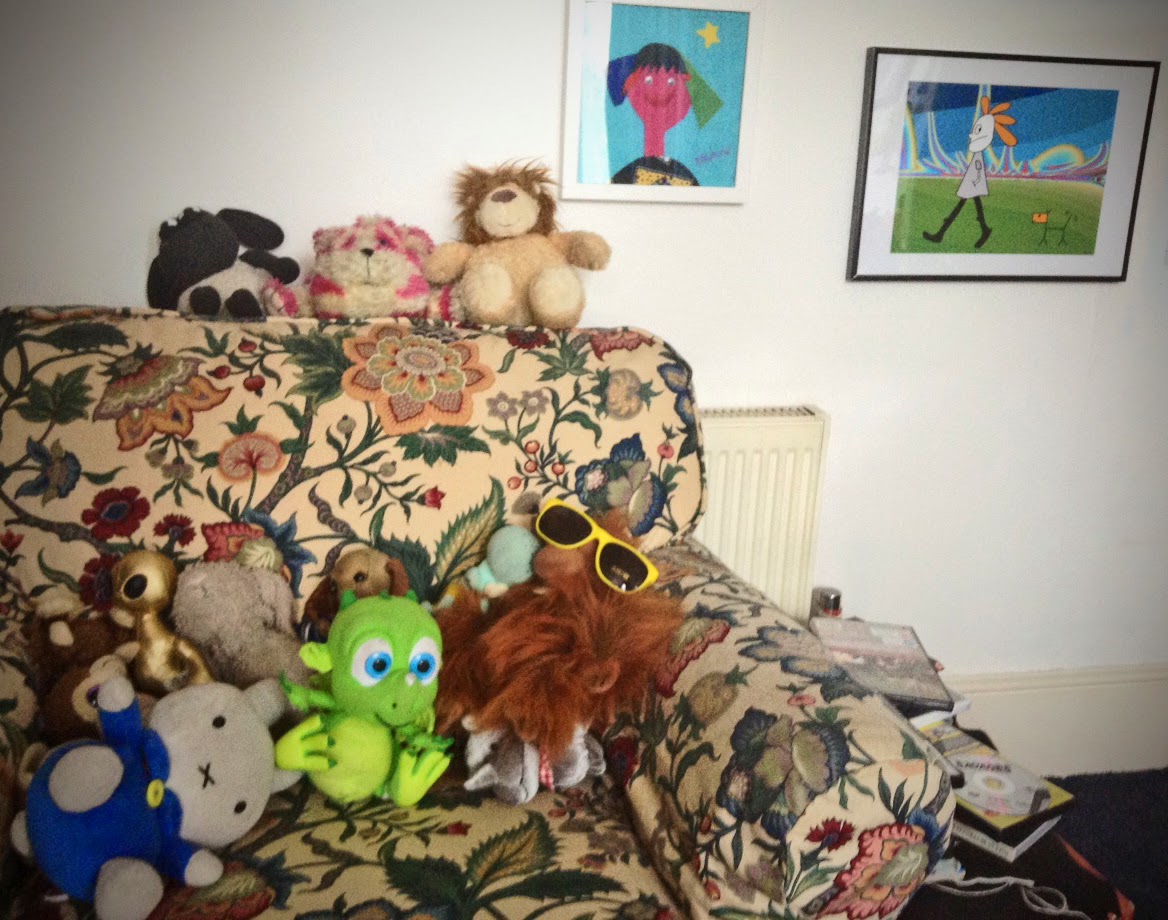
In my caravan I have no tv, no wi-fi, just a few books, old illustrated maps of the continents, and a couple of my jazz bottles with Queen Ida and a blue Miles Davis. I also have silence. A silence so deep, sometimes it's almost scary. But mostly beautiful. I can stare at the flowery curtains and drift away into a natural meditative state. I also have a few pens and colours and paper. Sometimes I draw, sometimes I just sit outside reading travel books and feeling the grass with my bare feet. Everything is perfect. Then I come back home, open the door, and I am immediately overwhelmed by... stuff. I've accumulated so much stuff, books, cds, gadgets, art supplies, cameras, nick-knacks, pictures, canvasses, art magazines, sketchbooks, full and blank. I sit on my couch, shoving some of the fluffy toys and cushions out of the way and I stare at the blank tv with a sense of dismay and anxiety. Why? Because every single object requires a decision - namely, should I use it or not. And it entails further decisions to make, such as how to use it and why. The other source of anxiety is the fear of losing what I've got. Apart from physically losing something, there is the retrieving form of losing. I flicked through a Tate magazine that had an article on Malevich, and when I put the magazine into the recycling bin, I thought, "Now I am not going to remember Malevich, his work, his theories, his sputniks and planits." And that made me incredibly sad. I write, sometimes I write a lot, in notebooks, in my computer, on my phone. But where does all the stuff I write end up? How do I archive it for retrieval? The simple caravan life is lost in the city, with its deluge of information and stuff that should be used, retained, accessed, retrieved, remembered. And a flowery curtain is not enough to induce meditation under the bombardment of phone calls, emails, post, bills, magazines, tv. And then there are art galleries, exhibitions, sketching and photography outings. A sea of stuff.
I often wondered why monks choose gardens, ponds, rocks, mountains or the sea to meditate. I thought that was cheating. Too easy to go to a beautiful place, sit on a solitary bench in the sun and watch kois glide by in the pond, perhaps with dreamy wind chimes and birds singing in the background. Because then you go back to all your stuff, and your heartbeat is raised, by millions of stimuli and a sense of guilt and powerlessness. But someone explained to me that the more you expose yourself to calm, meditative environments, the easier it becomes to access that state, to remember it when you are surrounded by stuff. So here is what I learnt in two days on my caravan. I don't NEED stuff. I don't need to retrieve or archive anything apart from what gets automatically stored and catalogued in my memory. I will remember Malevich when I need to. Or not, and then I'll do without his sputniks and black paintings, because I will be engaged in something equally valuable. As to my writings, it will be a constant journey of rediscovery, like a goldfish in a bowl swimming past a castle. Oh what a beautiful castle.