Friday, 17 March 2017

Ideas and how to retain them


Where do I get my inspirations from? Easy. I get inspired by a lot of things. I see or read or hear something, and I get an idea. The problem is how to retain it. I might go to an art gallery and see a painting that inspires me. The inspiration I get very often has little to do with the original work. I don’t want to copy a certain painting, I want to retain and work and pass on the inspiration that came to me by looking at that painting. So how do I do that? Taking a picture of that painting doesn’t seem to work. When I look at it later, it doesn’t talk to me in the same way. The other solution is key words, but on their own they also lose strength. I tried different apps, like Evernote, OneNote, google keep. They are definitely useful but what I would need is an app that helps me identify and retain my mental process, that goes from the trigger, i.e. the painting or book or conversation, to the excitement that precedes the idea, to the idea itself. I somewhat think that it would work in columns or panels. Brief description or picture of the work; raw impressions, ways of translating it into my creative world. While I wait for somebody to come up with this ideas app, I might just stick to a notebook, and then read it aloud into google docs and organise it later .
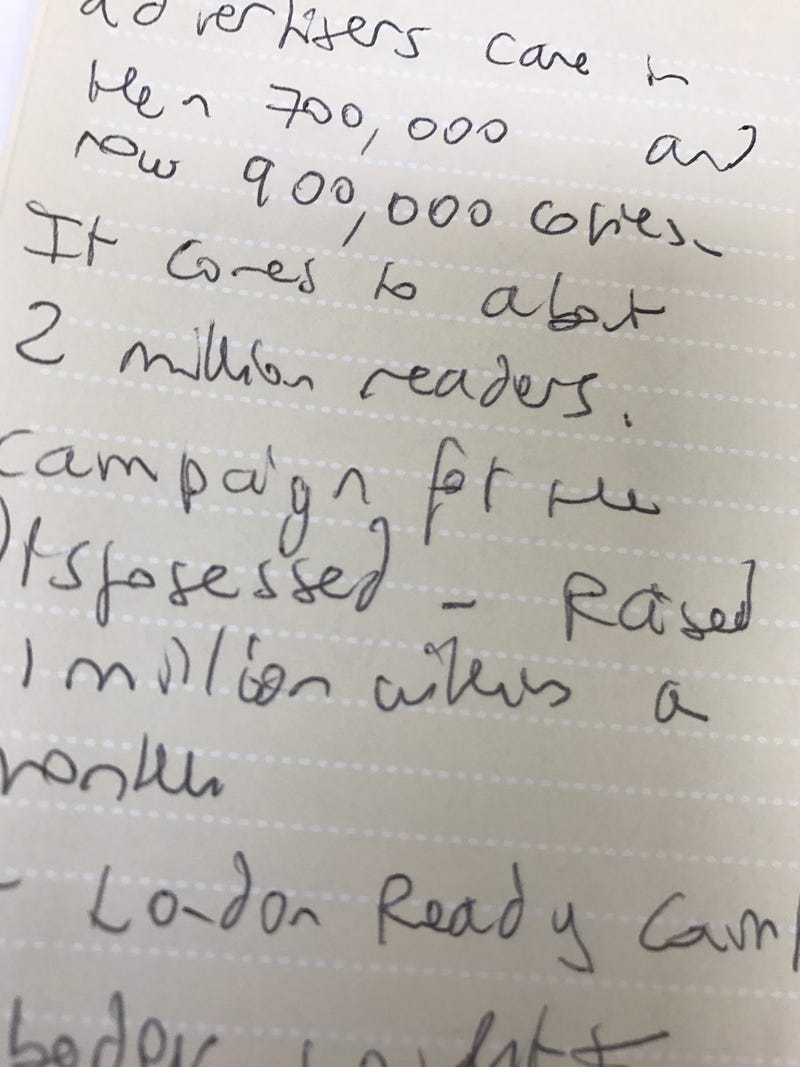
Why do I find it more useful in retaining ideas than writing on Evernote on my phone? Two reasons: I can’t type as fast as I think, but also in my notes I doodle and also my writing changes with my emotions and so the written note seems to retain more of my mood at the time of writing.
As I said, I get inspired by a lot of things, so I’m never short of ideas, but still, a lot of thoughts get lost and perhaps some of them are good thoughts.

Originally posted on medium

Wednesday, 11 January 2017

Reflections upon 2016


I'm at a bloggers meetup, there are about ten people around a white table with colourful jellybeans that I seem to be the only one eating. We are all writing about last year and next year. So, here goes. In January I found it more difficult to walk. In February I went to Malta on a cricket trip with the Eccentrics cricket team. Malta was amazing, like something I've never seen and yet remember. It was medieval and full of imaginary Knights roaming the dusty streets. Hubby injured his ankle at the cricket match and I almost laughed thinking that now I had to help him walk. In April I got a brand new hip, hubby cooked and I spent the days weaving,
making jewellery and relearning to walk. I then walked in Italy and in the California desert. 2016 was good. 2017 will be my blogging year, where I won't let validation sickness get in the way of my creativity. I'll keep on growing like a tree, twisted and torn, but with many new branches, a few dead leaves and lots of new green ones. I will be like my cherry tree in the winter. Proud of change.

Thursday, 29 September 2016

Colours


We walked into the little hut that is David Hul's Scrimshaw Studio in Julian, Ca. While we were admiring all his decorated skulls and knives and learning about scrimshaw, David said to me, 'You are very colourful!'. I'm not sure it was meant as a compliment, but it made me smile, because the more I travel, the more I tend to accumulate layers of colour, mementos, souvenirs, gifts, in a happy, wild confusion. While I move through space and time, the stationary residents look at me with amusement or, rather, bemusement. When I think of this layering, tattoos of experience and memory, good and bad branding on the skin or the heart or the wrinkles, I think of my long lost copy of Superslave, gone AWOL sometime at the end of the Seventies. I always thought of buying it again, but never did. What I remember of Superslave is that he was going on a lot of adventures. These adventures changed him, his hair was shorter or longer, the clothes different. In most of the adventures Superslave died, and came back to life with a new tattoo that symbolised his new death - if he drowned, he would have a tattoo of waves, etc. He ended up covered in tattoos.


I didn't ask David Hul what tattoos he might have accumulated in his life as a California scrimshaw artist, but his studio was layered with so many things, bones, pictures, books. I could have spent hours in there, but I didn't. I guess I thought I could just 'look him up later', but David is an off the grid type of guy, so I lost a great opportunity for learning. Perhaps because I was momentarily blinded by protagonism, I forgot how to be an explorer and discover more. All I could find online later was this amazing picture of him in his studio.


Saturday, 3 September 2016

Interesting


Others have an otherness that seems so perfect. Otherness is the only thing I cannot achieve. I wonder if others can achieve it. Or if it's the limit of being self that you can never quite surprise yourself as novelty can. There is a mystery in other that I don't quite find in self. A new dress before it is worn promises things that dissipate once worn. I guess that, although I am a very curious person, I don't seem to have much curiosity for self, I don't believe there is a mystery about me, just a work in progress. Hence, I have to move on, all the time. Other, well, other cannot but move all the time, blurred like trees from a train. I want to stop the blur, I want to remember, but as soon as I do, it becomes self.


Location:Deal, Kent

Sunday, 3 July 2016

On identity, value and more


First of all, this is not one of my works, it's Bernard Meadows. I believe. In a way it could be my work. I spend my days looking for mirrors, stories that could be my stories, I collect, to save memories, mine and others', in pleasant confusion, happy to lose my boundaries between me and my story. I don't remember the titles of the books I read. I don't remember where that pebble or that trinket comes from. But I do remember that everything I collect is there because it's important to me, it informs who I am. I'd like to think that others might be collecting me as part of blurring their own boundaries. Sometimes I feel that it's so hard to be collected, one pebble on a shingle beach. That makes me sad and makes me question my collection and my value. And then I start losing things, moments, creations. Because the round peg doesn't fit in the square hole I feel like giving up to avoid bashing it in. But perhaps the solution is to leave the peg sitting on the box with the holes and let others try to make it fit or not, while I keep on collecting.

Location:Mayfair

Wednesday, 4 May 2016

On weaving and other stories


The word 'trama' in Italian means both weft and plot.  Perhaps because of that, I have always associated weaving with narrative. Perhaps, also, because I was thinking of Penelope's web which seemed to unravel parallel to Odysseus's journey. I don't know if weft and plot have etymological affinities in English, but the word 'thread' for instance is used to describe a continuity in a situation or story. Stories have been woven and embroidered throughout times and cultures. But it was only when I started weaving that I understood why at a deeper level. Everything gets woven into your fabric, the music you are listening to, your thoughts, your memories. It also becomes a way of making sense of things, 'string' them together. My interest for weaving, and, more generally, for fibre art, I think started from a passion for upcycling, repurposing, finding ways to use scraps of anything, paper, cardboard, and, of course, fabric and yarn. For some reason, this journey kept on taking me back to Japan, where recycling is not just a modern buzzword, a concept used to soothe the consumer's sense of guilt. Creative reuse of  material has existed in Japan for hundreds of years.  At the basis of it is the concept of 'mottainai', a regret for waste. 'Mottainai' is an old Buddhist word, linked to the Shinto idea that objects have souls. 'Boro' is the clothing used by peasants and artisans between the 17th and the 19th century. Basically they are garments made of rags, often in indigo shades, stitched together, patches to repair old clothes. And because of that, they are also journals, memoires, mementos of clothes once belonged to parents and grandparents. The other word that inspired the little handbag I made, is 'sakiori', narrow strips of worn out fabric weaved into new fabric. Which is what I did here, with and old piece of lining fabric. I also used my very primitive version of  'sashiko', a functional embroidery used to reinforce fabric. The world of Japanese textile art is amazingly inspiring, and I have only scraped the surface here. But this handbag I made, while waiting for my hip to heal, was a great experience, completely sewn by hand, with recycled materials, it contains a little part of my soul.

Sunday, 1 May 2016

Living the 'hippy' life


Being the proud owner of the most awkward furniture in the world, I resorted to the teachings of the princess on the pea, and piled up all sorts of cushions, pillows, throws and towels to prop myself up into a bearable position. On one side of this chair there's a stereo, on the other a table full of my weaving junk. That weird instrument with a yellow handle is a reacher. So, I sit on my chair, listen to music and weave on a children's lap loom. And the mind explores whatever it wants, enjoying the no-pressure zone allowed by the general reduced functionality. So, here goes. I was listening to a radio station algorithmed to match my musical tastes and, surprisingly, it did. Although it had a stronger inclination towards Delta blues than I would naturally have, but I didn't mind. Weaving and dreaming, I ended up in a trailer on the Mississippi river, where a number of different gigantic ladies in crutches were pirohuetting with extreme agility around their environment. Cooking pie, playing acoustic guitar, then getting inside their battered car to go have a drink in some remote run down bar with an analogue clock. And I sang a funeral dirge in my head, for old metal analogue clocks, that are now bought only by hipstery craftbeerers, as a statement.
Getting back to my large lady on crutches, I admire her dexterity. My crutches fall all the time, or they end up miles away from me, or they slip off my arm. The reacher, well, that's another story, it basically has the lamest clamp, and loses grip on heavy objects. Trying to lift a bottle of water from the floor yesterday was almost comical. Ir reminded me of people trying to start a fire with flint. You can either freak out, turn your husband into a full time butler or nurse, or get back to a time in which things took time. That was how it was, and it was not questioned. If it takes half an hour to lift a bottle of water, than that be it. To slow right down like that is actually not bad, it's a humbling, spiritual experience. In the end you feel very calm, and wonder why you ever rushed.
My reacher has a magnetic tip, and I was wondering why, until I dropped all my needles.
Summary of first week with new hip: I spend most of my time dropping things and picking them up, misplacing the crutches, remembering things that I need only once I'm sitting down. Weaving, lots of weaving. I will explore this subject in the next few days, and take you on a dream journey of ancient Japan...